
I Coach Disruptors ⚠️ Here Are Signs You're One Of Them 🛑
To fully accept myself I had to come to terms with my identity as a DISTRUPTOR. Once I did that I felt more whole, more complete in my identity. And I started to notice how my clients tended to be disruptors themselves!

Calm down.
Don’t be so emotional.
You’re overreacting.
You’re too intense.
All of these comments make my blood boil. Because I know internally these comments are meant to silence me, to make me smaller, tone me down, or control me. I’ve been told these things all my life. Growing up as an empathic kid, one who felt emotional overwhelm when someone was mistreated, I tended to speak up or ask questions to understand why the world was the way it was. And not everyone was comfortable with that.
But as I grew into my teenage years and young adulthood, I did what most people do; I molded to the comments and I consciously or subconsciously agreed to the judgments or gaslighting (we didn’t have that term growing up, btw). I think I submitted to keep myself safe from harm or from being ostracized.
But over time, as my career developed, I realized the choice to be silenced cost me my voice and my agency. Because I was outspoken, it cost me jobs. I literally was pushed out of positions because I was pointing out unethical practices and institutional racism with my higher-ups. This happened twice.
Now that I think about it, as I was building up my leadership, I really didn’t have role models for my rage. Coaching wasn’t a thing offered for professional development, and most of what was out there were diversity programs; aka, failed attempts to have us conform to the status quo, white supremacy culture in the workplace.
I wish I had the language, rhetoric, and supportive environments that embraced my fiery nature instead of teaching me how to be more likable.
So, how did I end up finding my voice/agency and embracing my natural rage? TBH, I had to reach outside of my professional career and resources and start working on myself on a personal level. I couldn’t have come to the place I’m in now, fully on my path as a coach, healer, and facilitator, had I not stretched myself to go into spiritual development.
Now that I’ve blended all parts of my leadership into my coaching style, I realized that I tend to have clients who resemble a lot of who I am and what I’ve gone through in life. I guess you can say it’s the way that my life lessons are now available to share and support others on a similar path!
To fully accept myself I had to come to terms with my identity as a DISTRUPTOR. Once I did that I felt more whole, more complete in my identity. And I started to notice how my clients tended to be disruptors themselves! Suddenly I can recognize the rage, the frustration, and support them in a way that celebrates and empowers the change agents they are (without them losing their jobs, of coarse)!
So, over these last 9 years of working with leaders 1:1, I noticed the traits below as the
DISRUPTOR ARCHETYPE.
Are you one of them? How many can you say "yes" to?
Stands firm on beliefs of justice and truth: They are willing to risk positions of power to advocate for what they believe is right, acting as altruists of truth and universal law.
Possesses powerful, often unseen accomplishments: Their past successes are not public but serve as a "secret weapon," providing a high moral ground from which they operate.
Highly aware, empathic, and educated on societal dysfunction: They understand the root causes of problems and are fierce advocates for solutions that align with nature and universal/natural law.
Needs balance and deep human connection: Despite their fiery nature, they crave validation, human-centered relationships, and deeper connections to prevent burnout.
Looks to nature for validation and guidance: They believe nature holds the answers for healing and "setting things right," trusting it to guide their approach to change.
If you answered yes to all, let’s flip the script on what it means to be a disruptor and make changes in our organizations without losing a job, having fallouts in relationships, or feeling alone and “too much” of anything. You’re more than enough, you’re meant to do this work!
My private 1:1 spaces are here to accept and witness ALL of you, to nurture and embrace all the rage you've been containing. Despite what your external environment tells you about who you should be, you already know who you are in all the heightened emotions that come up when in the face of injustices. Let's get to the root of your beliefs and how you see the world doing better, being better for the sake of the collective shift towards right relationship with each other. Let's work together to find a more effective way as you contribute on the frontlines!
Let’s find a time on my calendar to talk about ways you can cultivate your leadership THROUGH your rage and characteristic of being a DISRUPTOR!
THANK YOU FOR READING MY STORY!
IF YOU FOUND THIS RESOURCE HELPFUL
PLEASE SHARE WIDELY TO YOUR NETWORKS & FRIENDS
Comment below to dialogue with me!


Coach, Therapist, or Both? 3 Questions to Help You Find A Practitioner
I often get asked what the differences are between these practices by prospective clients, especially those who haven’t worked with a coach before. So I want to offer some key questions to reflect on so you can get clear on who the right practitioner may be right for you, as you begin your search.
Ultimately, it’s about finding a match in chemistry with someone who’ll hold you through vulnerable and tender moments.
As the need for mental wellness increases in these times of social unrest, the amount of services and resources available for support has also increased. With online companies that provide easy access and almost on-demand support like BetterHelp or TalkSpace, beginning the search for the right practitioner can be overwhelming. Taking intentional time to trully reflect on what your self-development needs are can clear up some fog and help you see precisely who you’re looking for and where to find them.

Ultimately, the decision and investment to work with someone who is there to hold some of the most intimate moments and tender parts of you depends so much on the chemistry and overall vibe you receive when interviewing them for their services. So, before you start the “matching” game for your support person, let’s get clear on what kind of support might be more aligned with your needs and preferences for self-development and healing.
In this post, I wanted to share the specific distinctions between a coach and a therapist because I often get asked what the differences are by prospective clients, especially those who haven’t worked with a coach before or only worked with one for a very specific and short-term purpose related to the workplace. I want to offer some key questions to reflect on so you can get clear on who the right practitioner may be for you, and then begin your search.
I’ve never been a therapist, but I have had therapists before. So I can’t speak to that skill set or its requirements to be in practice. I can only let you know how I see coaching as different from therapy based on my perspective as a coach.
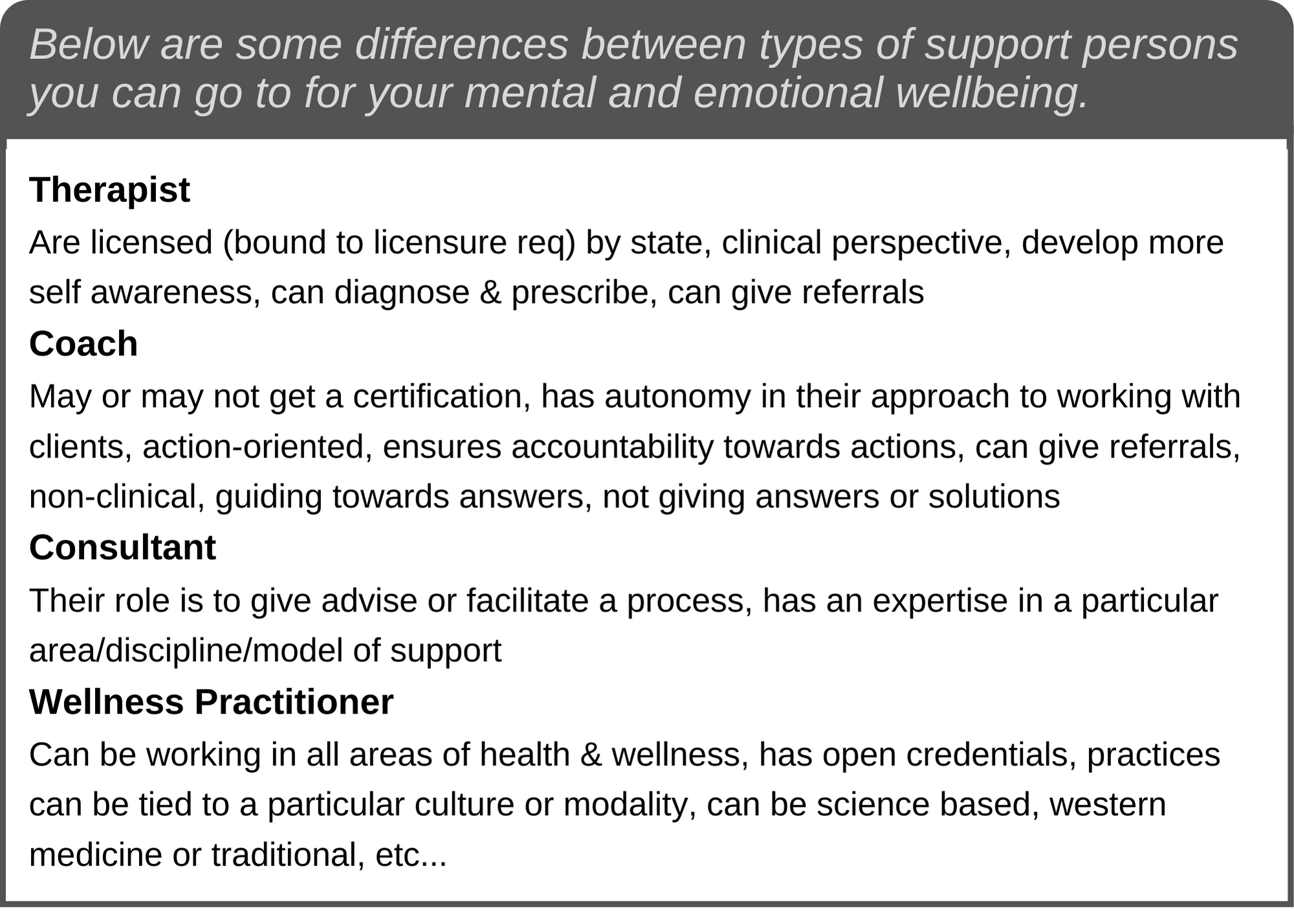
Image from nature-based coaching essentials workbooks. Rinoconsultingsolutions©️
First, coaching is often viewed as focused on a person’s career path and navigation toward higher leadership or productivity. No doubt, coaching is not as well known as therapy as a form of private support because the industry really began in corporate America. If you ask people what coaching is, more often than not, you’ll get vague answers or something to the effect of being a counselor or mentor to be a better worker/leader., I won’t get into the weeds of the differences between the roles of counselor or mentor, but they are different.
First, I’ll name what each practice is
Coaching often centers on a specific profession or industry for a certain period of time, or until you’ve achieved what you set out to achieve; a higher position, create a new business, etc. You can have coaches specific to building a business, developing speaking skills, helping you write a book, or like me supporting you in cultivating healing-centered empowered leadership. The industry of coaching isn’t highly regulated and most coaches don’t have to be certified to call themselves a coach. Doing your research and interviewing each one is highly advised.
Therapists are clinicians and often have to comply as such, like only providing service to the state they live in. So going through specific training/licensure and rigorous levels of certification and regulation are required because these clinicians are tied to the Western medical and clinical lens of addressing disease, disorders, or rehabilitation and such. They treat patients and can prescribe medications or identify diagnoses.
I believe both practices are beneficial in their own ways, based on what support a person needs. What I appreciate about being a coach is that I get to blend different modalities and frameworks of healing without the restrictions of licensure. I blend my life experiences, ecology and science education, and leadership development with my spiritual connection to nature. A therapist might have the flexibility to create a particular niche of therapy, but they are also required to avoid the risk of non-compliance. One simple example of a licensure limit is that depending on the state, a psychotherapist cannot provide services to clients living outside of the state they are licensed.
As a coach location doesn’t matter and I can also include things like dream interpretation, ancestral healing, or other psychotherapy frameworks and approaches. I have more flexibility and autonomy to blend, shapeshift, or adapt to my client's needs for healing. And because my journey to becoming a coach was heavily influenced by my identity and needing to find effective ways to support diverse leaders, I created my own framework of healing! My Radical Nature Framework grounds my practice in core principles of nature.
Now, I’m not here to sway you in one direction or another. I believe the right kind of support should go to the person based on their specific needs. So, personally an ideal situation for my mental and spiritual wellness needs would be hafing both a coach and a therapist.
So let’s start parsing out the types of support and what some main differences I can share so you can better discern what kind of support will be the most beneficial on your healing journey:
Here are three prompts you can reflect on:
What motivates you?
Thinking about what your wellness needs mean by thinking about how you want things to be different and who you want to be by the time you finish receiving support. As a coach, I need to hear goals or aspirations so that I know where I’ll be guiding you towards. A therapist may not ask you what the future of your time together can look like because the focus is on what you present each session and healing from the past, primarily.

Is accountability important to you?
Designing action steps and providing accountability for your growth and development is central to the coaching practice. I’m thinking about the shifts you want to make, what’s in the way of achieving that, and cheering you on as you approach those milestones. In my experience, a therapist isn’t so much tied to the outcomes but rather can be that supportive practitioner to help you see and name the things that may be coming up in your thought processes and behaviors. I think both can include accountability, but in coaching it’s essential. In therapy, it may be optional.
Where are you starting? Where’s your trailhead?
This is an important one to be able to speak on. As I mentioned, coaches aren’t regulated and therapists are clinicians. Because my industry isn’t regulated I need to be on my toes about the ethics of coaching. That’s why I went through (recommended) certification. If you feel that your mental health needs may exceed professional support and you’re not sure if there may be a clinical diagnosis to consider, start by talking to a therapist. If you feel ready to put some action behind your self-discovery and healing journey, you may be primed for working with a coach who can stretch or challenge you to do things outside of your comfort zone. Are you starting this work feeling extremely raw or tender? Consider a therapist. Or are you raw and tender and feel a burning desire to get proactive about changing how things are right now? You may be ready for coaching.
Other expectations:
These are a given, but are worth mentioning.
Unfortunately in our society, individual support services are expensive and often NOT subsidized by the government or your employer. So, many people go underserved and our society’s mental health needs progress slower than a snail’s pace. But I’m someone who lives my life with the value of self-determination. So, I believe we all can get free and those of us privileged to know how to do that can to share that!
Here are some other tips for making this important work of self-development arrive in your life:
Get serious about your wellness in the form of financial wellness because our money wealth is a mirror of our sense of self-worth and value. So start building that personal wellness fund and work out installment plans or barter with practitioners who are in the position to. Don’t be afraid to ask your community to pitch in. We need you at your best!
Believe there are those out there who can truly love and support you and won’t hurt or abandon you during your process. That’s why interviews and referrals are key in deciding who to work with. And always, always check the vibe (in your gut) and trust that! Let practitioners know that you’ve been hurt before and/or what’s not going to work for you when you’re in a sacred space with them. If you’ve given them notice up front, you’ve already won by advocating for yourself!
If you’re ready to step into a program with me, don’t hesitate to book a quick consultation with me to see if we’re a good match!
You can also find out more about organizations I’ve coached for or which community-based directories I’m on!
LEAP (Leadership Education for Asian Pacifics)

Attuning to Nature’s Rhythm by Mapping Out Workload Overwhelm
If an overwhelming workload is most present for you, I've got you covered with this simple diagram to help you chip away at that heaping pile of things to do so you can ease into a moment of pause or spaciousness. I share to help you manage your task list so you can manage your time, energy, and specifically your emotional well-being.
Attuning to nature’s rhythm can be challenging in a world…
that is structured around production and the engine of capitalism. Our bodies aren’t naturally designed to physically work through stress or times of the year, like wintertime. But how do we strike a balance of being in this word and in our human bodies? Here’s a tool I’ve found used across many industries from leadership development to corporate wellness so that leaders can avoid negative impacts such as burnout or exhaustion. If an abundant workload is most present for you, I've got you covered with this simple diagram to help you chip away at that heaping pile of things to do so you can ease into a moment of pause or spaciousness.
No doubt, you can use the graph below to manage your task list, which in turn manages your time, energy, and ultimately managing your emotional well-being so you can more effectively sustain the change in this world you’re working towards.

So, I'll be truthful to you, the graph below isn't the entire answer to your busy-ness and overwhelm, but it gives you a good start in thinking more critically about your time and what you're placing value on. It's a good "workload" reset with respect to what you think is important versus urgent. And yes, “important” and “urgent” are not the same thing!

So, let's get to sorting your mess out. According to your goals for the week, take your huge list and split tasks into either "URGENT" or "IMPORTANT". Don't think too hard about this and go with what your gut reaction. Now, we examine what kind of urgent and what kind of important is it?
Take a look at the graph I created below. The more urgent a task is, the more of a time suck it is and will get you caught up in a storm. The more important the task is for you, the more likely you'll make time for it and put it in your schedule.
So, let me break it down even more for you…

TORNADO - This is the danger zone. When a task is too urgent it tends to take up and drain us of our energy and attention, leaving you at risk of getting swept up in the chaos. Do you have a task that’s sweeping you away from your goals like a storm?
BOXING GLOVE - These tasks are both important and urgent, so these you want to just knock out. Get them done, that’s just what needs to happen. It’s like, LUNCH at noon!
TRASH - These tasks are neither urgent or important. Somehow they made their way onto your list, but the consequences are minimal and just get in the way. Toss it!
CALENDAR - I always say, what’s important to you will be what you make time for. So, if you regard a particular task as more important than urgent, leap into your planner and block off an empty slot for it!
NOW, let’s do a quick recap on the steps:
Gather or set some clear goals for your week.
According to those goals, list out all the tasks involved in meeting that goal or project.
For each goal, mark them on the graph in its respective place, or quadrant.
Take a step back and see if your graph feels reasonable to you, holding your GOALS as the anchor.
Are tasks in their proper places to meet your goals?
What needs to be switched around so that you are successful in meeting achievable goals?
Now take a deep breath! I mentioned before, this isn’t the answer to end all overwhelm with your busy and your impactful life, but rather it’s a worthy step forward in the direction of really understanding where your time is spent and how you value the limited amount of time we have in a day.
TIME MANAGEMENT IS A PRACTICE AND REQUIRES OPPORTUNITIES TO GROW FROM LEARNING MORE ABOUT HOW YOU FUNCTION
This activity can also reveal more clarity about how you hold boundaries. If you’re a people pleaser you might find that most of your tasks are in the “tornado” because you’re meeting other people’s needs. Or you might find the trash bin quadrant empty. Challenge that by really examining if tasks are really important or urgent; you might be “catastrophizing” the circumstances around tossing that task out.
The last thing I want to mention here is about your organization tools how they can be helpful for the follow through of your workload. I find these tools are often used by high functioning, leaders in high demand as a game changer that can tame the madness. For me, I looked into different journaling strategies (bullet journal, best self journal, etc...) to stay organized and have collected my own combination of reflection and planning sections. I made it work for me. And I would say I have my own customized diary-like planner/journal that I populate every Sunday night to get my week started.
Want more tools like this? Sign up for the newsletter to get tools and resources directly into your inbox!

What is Trauma Informed Coaching?
Listen in on this conversation I have with Reva Patwardhan, of Greater Good Coaching as we talk about
What trauma informed coaching is
What oppression informed coaching is
What’s important about these aspects of our practice as women coaches of color and how it shows up in ourselves as well as our clients
How we manage and do the work WE are responsible for doing to prevent causing more harm.
What is Trauma Informed Coaching?
with Coach Reva Patwardhan
Finding the right person to help you through major challenges in both life and career can get a little tricky for a person of color. Lack of options or financial access are certainly barriers. And the importance of representation in professional and personal services is becoming more and more a need and requirement in cultivating a safe and inclusive environment to do work where vulnerability is critical. Often times a disconnect or lack of cultural awareness on the part of the practitioner can cause more harm than help.
Listen in on this conversation I have with Reva Patwardhan, of Greater Good Coaching as we talk about
What trauma informed coaching is
What oppression informed coaching is
What’s important about these aspects of our practice as women coaches of color and how it shows up in ourselves as well as our clients
How we manage and do the work WE are responsible for doing to prevent causing more harm.
This was a really interesting and enjoyable conversation with Reva and I hope it sheds some light for you as you seek or work with practitioners that hold space for the more tender parts of your growth and development!
**Scroll down below the video to see the minute breakdown of the conversation!
00:33 Introductions
03:27 Why we coach
10:03 How healing shows up in our coaching
13:36 Defining trauma
20:20 Being trauma informed in our practice
23:26 Oppression informed coaching
29:23 Consequences of NOT being trauma & oppression informed
31:53 Being there for the client
38:32 It's okay to fire your coach!
41:25 Final messages from each coach
